
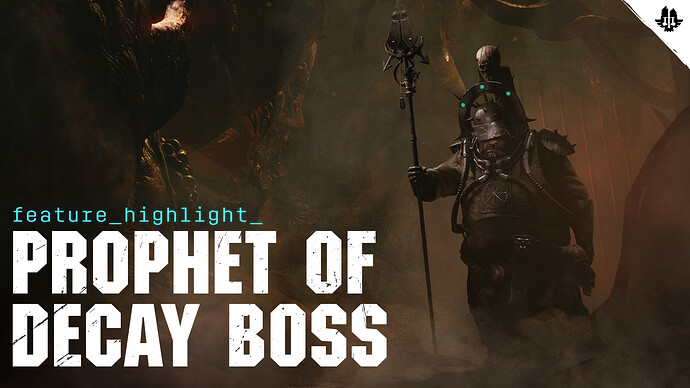
In this Feature Highlight we talk about the design of the new boss enemy of the Spillway level!

The new free update for Warhammer 40,000: Darktide, Depths of the Damned, comes loaded with new content for the game! Including a new mission, live story, weapons and boss fight.
In today’s Feature Highlight, we’ve interviewed our Enemy Designer Jonathan about the work that went into making the boss fight at the end of the new Spillway mission.
For those who have not played it yet, be wary of spoilers! This Feature Highlight will very candidly speak about how the boss plays and the story involved!
“My name is Jonathan. I work on Darktide and I’m the Enemy / Pacing Designer, so I’m a part of creating all the enemies and maintaining the Enemy Director of the game, primarily.” ~ Jonathan

Initial Design
A new boss enemy
We decided pretty early into development that we wanted to have a unique boss for the end event of the mission, and there were two main reasons for it. One is simply that we thought it’d be cool to make a new unique boss, since we haven’t introduced one since the Karnak Twins, and that this mission was a good opportunity to do that.
But on top of that, we’ve also been itching to introduce a Psyker enemy for a while, and whilst exploring different options of how to introduce one, we realized that a boss is a great way to do it.
“A Psyker is a very good medium for making a boss-type encounter since you can do a lot of warp stuff, which allows you a greater versatility and mobility in what you do with a boss. Especially compared to something that is melee, which is more limiting.” ~ Jonathan
We really wanted to play up the Psyker aspects of the fight, especially a Psyker of Nurgle, by emphasizing a lack of physicality in how he fights. This idea guided the design of not just how the Prophet attacks but also how he moves!
“He turns into flies and then, well, flies to wherever he wants to go. He doesn’t move anymore.” ~ Jonathan
Campaign and Adventure
As you saw when playing the mission (you DID play the mission, right?), the Prophet of Decay boss is none other than Rodin Karnak! The ritual has allowed him to take over a new body, bloated and rotten with Nurgle’s generous blessing, and with new Psyker abilities. (Though still voiced by the same talented voice actor as ever: Jack Myers)
The Spillway mission is part of the new mini campaign “Terrors of the Deep”, and while the campaign version of the mission represents the first time that Rodin has shown himself since the Dark Communion, players will still get to fight him again and again whenever they pick Spillway from the regular mission board. As he himself points out during the mission’s end cinematic, it is not so easy to get rid of one blessed by Nurgle as he is…
“It’s definitely going to be part of the normal mission pool, and also in Havoc, of course. And in Havoc, you know, it’s gonna be hard. There’s gonna be some additional stuff happening that might not happen in other difficulties.” ~ Jonathan
Gameplay Design - Fighting the Prophet of Decay
One of the biggest inspirations for how the Prophet of Decay bossfight functions is actually from Vermintide 2! Specifically Nurgloth the Eternal, the Lord fight at the end of Enchanter’s Lair, which was part of the Curse of Drachenfels campaign. The damaging ring mechanics, for instance, or the way the bosses use projectiles, were both heavily inspired by him.
“The first phase is the rings, similar to Nurgloth, ‘cause I always thought that they were a very cool mechanic and they work very well. Since a boss in a game like Darktide has to work in first person […] so we can’t do too crazy stuff, since you can’t look behind you. There’s a lot of, like, restrictions that makes a boss in Darktide something different compared to other games.” ~ Jonathan
Compared to Darktide’s other bossfights, this one is very structured, having three phases that players go through as they damage the Prophet as well as a very hand crafted pacing that controls things such as the boss getting winded and stopping for a moment while hordes of enemies swarm down, etc.
“It’s more of what you could call a ‘raid boss’ in other games.” ~ Jonathan
The first phase we settled on quite quickly, but the second and third phase required a lot more iteration; trying different ideas, testing them out, seeing what works and what doesn’t, polishing them and so on until finally landing on the version that went live with the Depths of the Damned update. An example of a scrapped idea was to have Phase 2 be about standing in specific spots and getting launched into the air if you failed to get to safety in time!
“[…] it is very hard to keep track of multiple focus points during the course of a fight. You have to focus on [the Boss], you have to focus on the normal enemies, but then you would also have to focus on a third element. So we had to ensure that that third element is […] noticeable enough that you can see it in your peripheral vision.” ~ Jonathan
Coming up with challenging, unique mechanics for the boss fight while working within the constraints that the limited field of view of a First Person perspective imposes was half of the challenge. Once we had a solid foundation for how the boss fight structure is, came the second half, which was fine tuning all of the elements to work together and make the final result, the entire fight itself, be a satisfying experience.
“[…] like, sure, you can make phases, you can make all of these mechanics, but unless you can make them work together in a cohesive manner, it’s not gonna feel good to play even if on a technical level it works.” ~ Jonathan
Things like how long should each phase take on average, how that changes per difficulty (from Uprising to Havoc 40), or even how to gate each phase. These all contribute to getting the feel of the fight just right.
Another detail that required a lot of fine tuning were the additional enemies that would swarm the players during the fight. They’re half of the fight by themselves, after all! For example, the ‘intermission’ sections where the Prophet is unable to attack are the only moments of the boss fight where ranged enemies may spawn.
In all other situations, only melee enemies can spawn, since dealing with the Prophet, the hazards he spawns, his projectiles and ranged enemies proved to be too much.
“That being said, the type of melee enemies are dependent on the difficulty you’re playing. […] If you’re playing on lower difficulties you’re only going to get Poxwalkers and other chaff-type enemies. But if you play on Damnation and up, you’re going to get Elites, including Ogryn enemies.” ~ Jonathan
On the subject of difficulty, the method we usually use for adjusting difficulty is to first pick a base difficulty, fine tune everything for that, and then adjust up and down for the difficulties near it. In this case, we actually had two bases to work from. The fight was fine tuned for Malice and Auric. The Uprising version was then based on the Malice baseline, while Damnation and Heresy were based on the Auric baseline.
Development Challenges
The Prophet of Decay is a very unique encounter, and many of the mechanics it uses required developing entirely new systems to handle them. Something as simple as having projectiles that can be broken by player attacks required a lot of work, because it wasn’t something that had been done in Darktide yet. In the second phase of the fight, players are encouraged to hide behind these spikes to save themselves from some attacks the boss is doing. Visually making the teeth block the particle effects required us to go deeper in our use of Render Targets, so there was a lot of new ground covered there as well.
The logic handling the phases and intermissions also required making new systems for governing the boss’ actions on top of its regular behavior, to give the fight the structure we envisioned.
But beyond all that, a boss fight like The Prophet of Decay is a really exciting project for us because it truly involves every single development craft on Darktide to work together on one thing to get every part of it just right. Game designers and coders implementing the enemy, level designers and artists preparing the boss arena and how it interacts with the boss’ hazards, story writers crafting Rodin Karnak’s narrative, Voice Over work, visual effects, sound effects, character artists and animators bringing the Prophet to life… And of course, the music!
“I think you have all the disciplines here, so it’s been really exciting.” ~ Jonathan
Bonus Question: What was your favorite part about working on the Prophet of Decay?
“On a bigger scale, getting to make a new boss for Darktide. On a more micro level, it’s been very fun building the underlying mechanic we have to make the boss a reality. We have a layer that sits on top of the normal behavior of the enemy that decides the phases, and how to handle the whole fight structure, really.” ~ Jonathan
That’s all we have for today! We hope you enjoyed this deeper look into the Prophet of Decay boss fight and his design!
We’ll see you on the Mourningstar.
– The Darktide Team
22 posts - 18 participants